Get in Touch
Amplience Is Built for Enterprise. So Why Is Amplience Development Dominated by Big System Integrators?

.webp)
Condividi la pagina:
Enterprise platform, enterprise integrator. It is a reasonable assumption, and Amplience's own partner list does not support it. Of the thirteen partners in Amplience's highest tier, four are global integrators and nine are specialist or mid-size agencies. The published Platinum criteria ask for a strategic partnership, a fully trained in-house Amplience team, proven delivery across multiple integrations and extensive technical knowledge. Firm size appears nowhere in them. That makes the useful shortlisting question not how big a partner is, but which of those four things they can put evidence behind, and this piece turns the criteria into questions you can ask in a first call.
Introduction: Check the Partner List Before You Believe the Perception
Ask around about who builds on Amplience and you will hear the same handful of global consultancies. The assumption behind that is straightforward: an enterprise content platform running a large retail catalog is enterprise work, and enterprise work goes to enterprise firms.
It is worth thirty seconds of checking, because Amplience publishes the list.
At AmpliFabrik we spend a fair amount of time on the other side of that assumption, usually with a buyer who has been told their only credible option carries a six-figure discovery phase. The useful thing to do in that conversation is not to argue. It is to open the partner directory.
Is Amplience development actually dominated by big integrators?
At the top tier, no. It is majority specialist.
Amplience runs a three-tier partner programme for integrators and agencies. Platinum is the highest, described as partners with "a proven track record of delivering high-quality Amplience solutions", who are "leaders in their fields". Thirteen companies hold it.
Four of those thirteen are global system integrators or networks: Accenture, Capgemini, Valtech and VML. The remaining nine are specialist or mid-size agencies: 64labs, Astound, Gradient Edge, Brave Bison, Grid Dynamics, KPS, Lab Digital, PixelMEDIA and Tryzens. The size classification is ours; the list is Amplience's.
Below Platinum, the pattern holds and widens. The Certified tier lists 39 companies and mixes large consultancies such as EPAM, LTIMindtree, Publicis Sapient and Ernst and Young with specialists like Orium, Pimberly, Fenom Digital and Zaelab. The Entry-level tier lists 28 more, including IBM and Infosys alongside regional agencies.
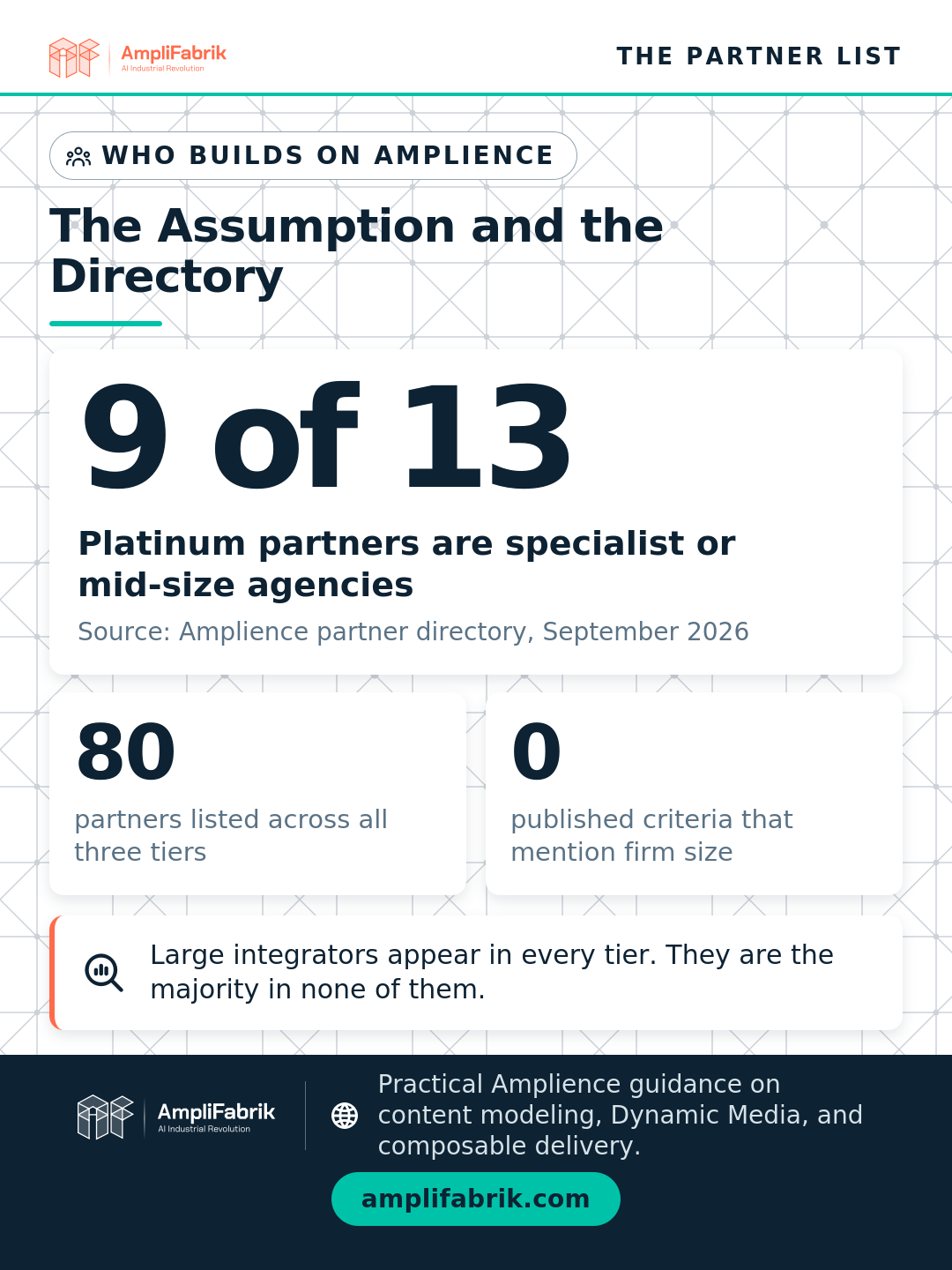
Eighty partner companies across three tiers. Large integrators are well represented and they are not the majority at any level.
Key Takeaway: The perception is real and the evidence for it is not. Before shortlisting, open Amplience's partner pages and count.
What does Amplience actually require of a partner?
Capability, evidenced. Read the criteria and notice what is absent.
For Platinum, Amplience asks for "a strategic partnership with Amplience", a "fully trained, in-house, dedicated Amplience team", "proven performance for delivering multiple successful integrations" and "extensive technical knowledge". For Certified, it asks for "a committed partnership with Amplience", "multiple team members with Amplience knowledge", "proven experience in delivering successful integrations" and "assured technical competence", plus completed sales and technical training and at least one successfully launched Amplience integration.
Headcount is not a criterion. Revenue is not a criterion. Geographic coverage is not a criterion. Every published requirement is about whether the team knows the platform and has shipped it.
That is a more useful shortlisting filter than firm size, and it converts neatly into questions you can ask in a first call.
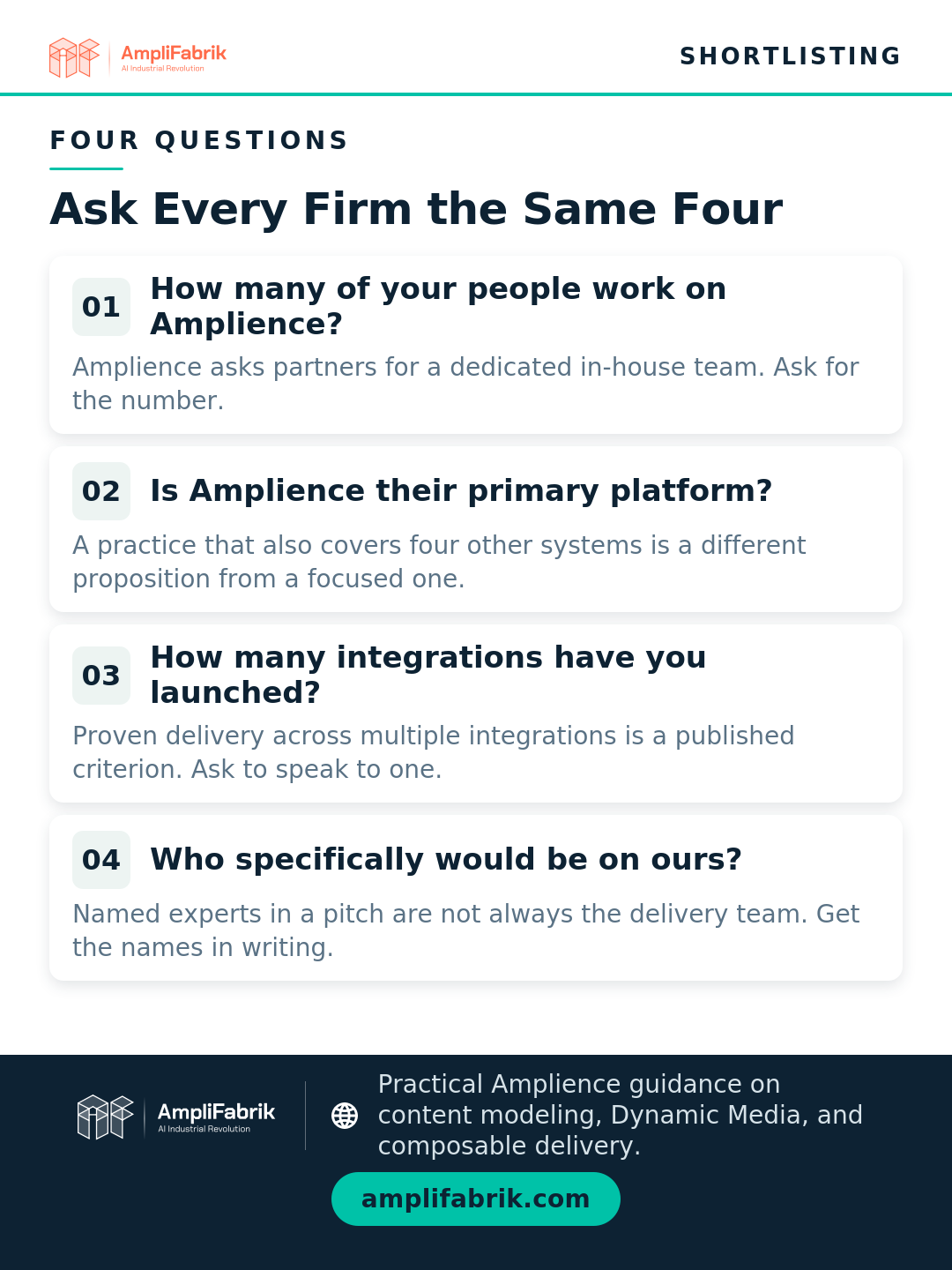
Key Takeaway: Ask for the four things Amplience asks for. A partner who cannot evidence them is not made safer by being large.
So why does the default go to the large integrator anyway?
Because the reasons are real, and they are mostly about the buying process rather than the build.
A large integrator is easier to get approved. They survive a procurement process designed to screen out risk: audited financials, insurance at the level legal wants, a master services agreement already on file, referenceable logos in the same vertical. A specialist agency can be the better technical choice and still fail at step one because nobody wants to explain the decision if it goes wrong.
There is also the scope question. Enterprise commerce programmes rarely stop at the CMS. If the same programme is replatforming the commerce engine, reworking the ERP integration, standing up a data layer and running change management across four markets, a firm that can staff all of it under one contract is solving a coordination problem that is genuinely hard.
And there is familiarity. If the last three programmes went to the same integrator, the fourth is a shorter conversation.
None of that is irrational. It is worth naming clearly, because an argument that pretends the default is stupid does not survive contact with the person who made it.
Key Takeaway: The large-integrator default is usually a procurement outcome, not a technical verdict. Know which one you are defending.
When is a large integrator the right answer?
Often enough that it is worth being specific rather than diplomatic.
Take the large integrator when the Amplience work is one workstream inside a multi-system programme and the hard part is coordination. Take them when you need a single accountable contract across commerce, content, data and integration. Take them when the programme spans several regions and needs people in each. Take them when your procurement or risk function has requirements a smaller firm cannot meet, and that is not negotiable. Take them when you want one vendor carrying delivery risk for a fixed scope at a size that would be existential for a small company.
If two or more of those apply, size is doing real work and a specialist is the wrong shape, however deep their platform knowledge.
Key Takeaway: If the hard part is coordination across systems, buy coordination. If the hard part is the platform, buy the platform.
When is a focused specialist the better fit?
When the Amplience work is the work, and the constraint is depth or speed rather than breadth.
The structural difference is what a day of senior time costs and how many people stand between the question and the answer. On an AmpliFabrik engagement the person who modeled your content types is in the call, which is less a service promise than an arithmetic consequence of the team being small. That matters more on platform work than it sounds, because the expensive decisions are architectural and they get made early, often in a discovery session before anyone has written code.
Key Takeaway: Buy breadth when the programme is broad. Buy depth when the platform is the risk.
How AmpliFabrik fits this picture
We are the second shape, and the way we are set up follows from that rather than from a positioning exercise.
Every practitioner here works exclusively with Amplience. That is a deliberate constraint with a cost: we are the wrong call for a programme that also needs an ERP workstream and a change-management function, and we say so early rather than stretching to cover it. What it buys is that the people on your project have seen the same content modeling decisions before, and there is no practice to spin up.
Coverage runs the lifecycle, from discovery and content modeling through implementation and launch into managed support, staffed with the roles that work needs: engineers, solutions architects, content architects, business analysts and delivery managers. Teams sit in Halifax, Fredericton, Saint John and Ottawa, which puts us in the same working hours as US and Canadian clients rather than handing questions to a rotation.
What we will not do: bid on a programme where the Amplience work is a minority of the scope, or take work we would need to hire against. Both are ways of becoming the wrong shape while telling a client otherwise.
If the platform is the risk, Delivery owns the build and Staff puts specialists inside your team. If the programme is broader, the honest answer is one of the integrators on Amplience's own list.
Conclusion: Shortlist on Evidence, Not on Size
Before the next shortlist, do two things that take under an hour between them.
Open Amplience's partner pages and read the tier criteria. Then turn them into four questions and ask every firm on your list the same ones: how many of your people work on Amplience, is it their main platform, how many integrations have you launched, and who specifically would be on ours.
The answers separate candidates faster than a capability deck, and they work regardless of which shape you end up choosing. If the honest read is that your programme needs coordination across four systems, buy that. If the honest read is that the content model is the thing that will hurt you, buy the people who have modeled one before.
AmpliFabrik is happy to be assessed on exactly those four questions, and to say when the answer points at a larger firm. If you want a second read on a shortlist you have already built, a health check on the existing environment is usually the cheaper place to start.
Frequently Asked Questions
Who are Amplience's implementation partners?
Amplience publishes them by tier. Platinum currently lists thirteen companies including Accenture, Capgemini, Valtech, VML, 64labs, Lab Digital, Tryzens and Gradient Edge. Certified lists 39, among them EPAM, Publicis Sapient, LTIMindtree, Orium and Zaelab. Entry-level lists a further 28, including IBM and Infosys. The directory is public and is the fastest way to sanity-check any shortlist you have been given.
Do you need a large system integrator to implement Amplience?
Not as a rule. Amplience's published partner criteria ask for a trained in-house Amplience team, proven delivery across multiple integrations, technical depth and a partnership with Amplience. None of them mention company size. A large integrator becomes the right answer when the Amplience work sits inside a wider multi-system programme, or when procurement and risk requirements rule out smaller firms.
What is the difference between Amplience Platinum and Certified partners?
Platinum asks for a strategic partnership, a fully trained dedicated in-house Amplience team, proven performance across multiple successful integrations and extensive technical knowledge. Certified asks for a committed partnership, multiple team members with Amplience knowledge, proven experience delivering integrations, assured technical competence, completed sales and technical training, and at least one launched Amplience integration. The difference is depth and volume of evidence rather than firm size.
How do I compare an integrator and a specialist fairly?
Ask both the same four questions drawn from Amplience's own criteria: how many of your people work on Amplience, is it their primary platform, how many Amplience integrations have you launched, and who specifically is on our team. Then ask what happens when the scope moves. A large firm absorbs it and a specialist may not, which is a real difference worth pricing rather than hiding.
Is a specialist agency riskier than a large integrator?
The risks differ rather than one being uniformly higher. A specialist carries concentration risk: fewer people, less capacity to absorb scope change, and a smaller balance sheet behind the contract. A large integrator carries dilution risk: the named experts in the pitch may not be the team delivering, and platform depth can be thinner than the logo suggests. Ask each about its own failure mode rather than about the other's.
Sources
You may also be interested