Get in Touch
Why Amplience Projects Need a Specialized Support Team, Not Just Generalist Developers


Condividi la pagina:
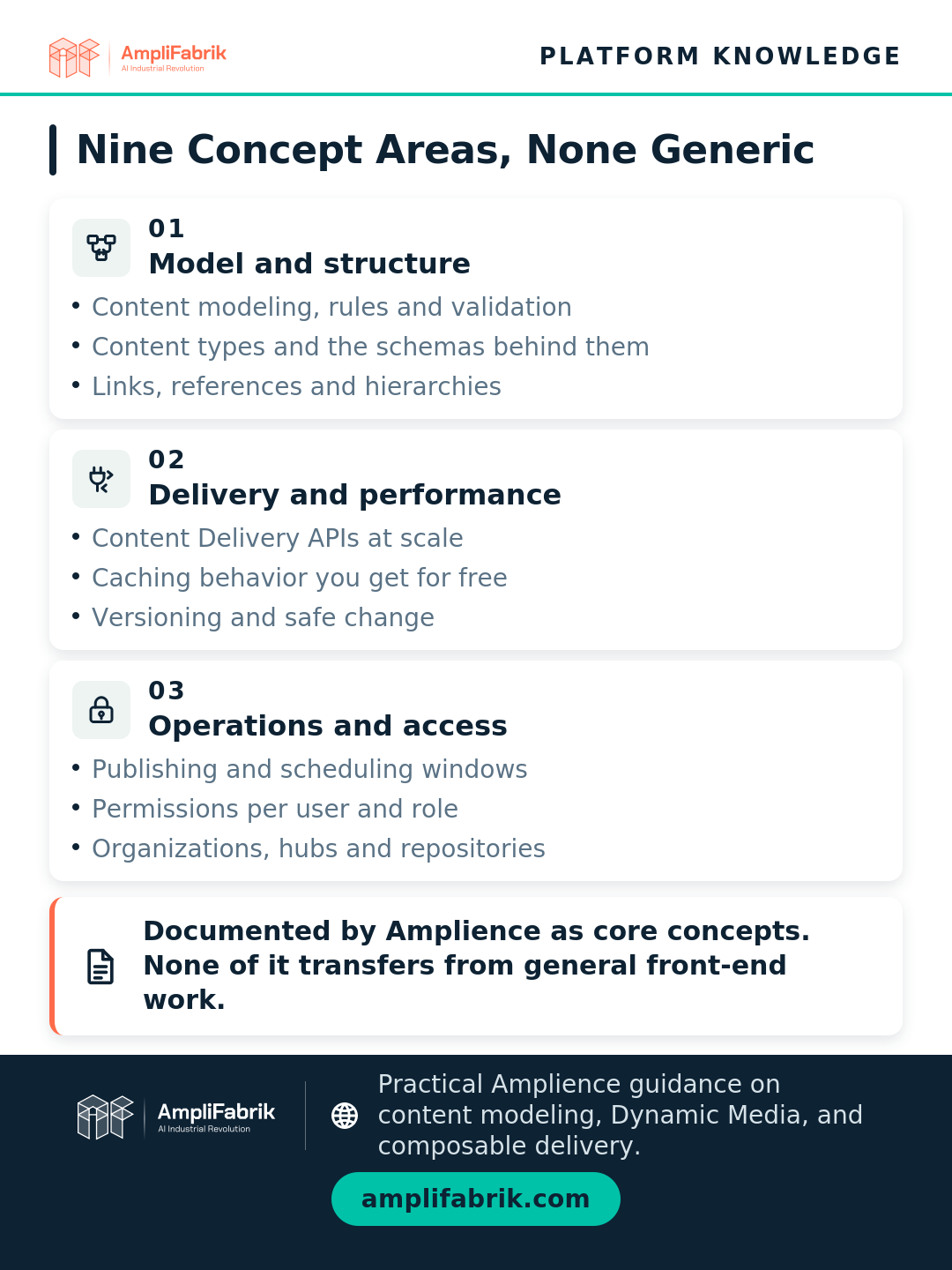
Your developers are probably fine. Amplience publishes nine core concept areas in its own documentation, covering content modeling, content types and schemas, relationships, delivery APIs, publishing and scheduling, versioning, caching, permissions and account structure. None of that arrives with general React, Node or ecommerce experience, and none of it is guessable from the admin interface, which is friendly enough to hide the depth behind it. The gap rarely announces itself. It shows up as a backlog that slips a sprint at a time rather than as a visible failure, and the fix is depth against the specific gap rather than a different team.
Introduction: Your Developers Are Not the Problem
There is a particular kind of stuck that shows up on enterprise CMS projects, and it does not look like failure. Nothing is broken. The team is shipping. It is just that each release takes longer than the last one, the content model keeps needing "one more field", and every question about how the platform behaves gets answered with a spike.
The requests that reach AmpliFabrik tend to share that shape. A capable team, a platform they half know, and a backlog slipping a sprint at a time with no single thing to point at.
This is not a story about bad developers. It is a story about a platform with a documented surface area that nobody on the project has been given time to learn.
What does a generalist developer actually hit first?
The admin interface, which is the trap, because it is friendly.
A competent developer opens Dynamic Content, sees something that behaves like a CMS, creates a content type, and builds a page. That works. The build continues for six or eight weeks on that basis, and the decisions made in the first fortnight are the ones that cost later: a schema shaped like the current design, content types that duplicate a block instead of sharing it, no hierarchy where the navigation needed one, and a delivery layer wired straight to the API with no caching strategy.
None of that produces an error. It produces a build that works now and resists every change afterwards. The team that made those choices is usually the team that has to live with them, which is why the slowdown gets read as a velocity problem rather than an architecture one.
Key Takeaway: If your team learned the platform on the project, the first two weeks of decisions are worth re-reading before you plan the next quarter.
What is there to actually know?
More than the admin interface suggests, and it is published, which makes this checkable rather than a matter of opinion.
Amplience documents nine core concept areas for Dynamic Content. In its own words: content modeling is "how to model your data structures, define your rules and enforce validation"; content types are "the foundation of your content"; relationships cover "content links, references and hierarchies"; content delivery is about retrieving "content at scale using our Content Delivery APIs"; and the remaining four are publishing and scheduling, versioning, caching and permissions, plus account structure, which covers "organizations, hubs and repositories".
Set that against what a strong generalist brings. React, Node, REST and GraphQL, CI/CD, a commerce engine or two. All of it necessary. None of it tells you how editions and slots interact, when a content link should be a reference instead, what caching behavior the Delivery API gives you for free, or how to promote a schema change between hubs without hand-editing anything.
That last one is a good example of knowledge that only exists in the doing. Amplience ships a command line tool for it, documented as a way to "automate and streamline your Amplience Dynamic Content workflows", covering how to "copy, import and export content types, schemas and settings" and how to "clean and clone hubs", from the command line or inside a CI/CD pipeline. A team that does not know it exists promotes changes by hand and calls it a release process.
Key Takeaway: Nine concept areas, none of them transferable. Ask your team to name four and you will learn where you stand.
Which problems does platform knowledge actually solve?
The useful version of this argument is specific, so here is the symptom-to-cause map we see repeat.
Read the middle column. None of those are hard problems once you know the platform, and each is expensive to discover by trial, because confirming it costs a release cycle.
Key Takeaway: If a symptom on the left has been live for more than a quarter, it is a knowledge gap, not a backlog item.
Does this mean replacing your agency?
No, and proposing that is usually how these conversations go wrong.
Your existing team holds things a specialist arriving on day one does not: the commercial context, the integration surface, the reasons behind decisions that look strange from outside, and the relationships that make a release possible. Replacing them to gain platform depth trades a known gap for an unknown one, and the replatforming work that follows a partner change is rarely cheaper than the problem it was meant to solve.
The alternative is narrower. Bring in depth against the specific gap, keep it alongside the team rather than above them, and make knowledge transfer an explicit deliverable rather than a hoped-for side effect. That can be a review of the existing model, a fixed piece of integration work, an engineer embedded for a quarter, or a support arrangement that answers the platform questions your agency would otherwise spike on.
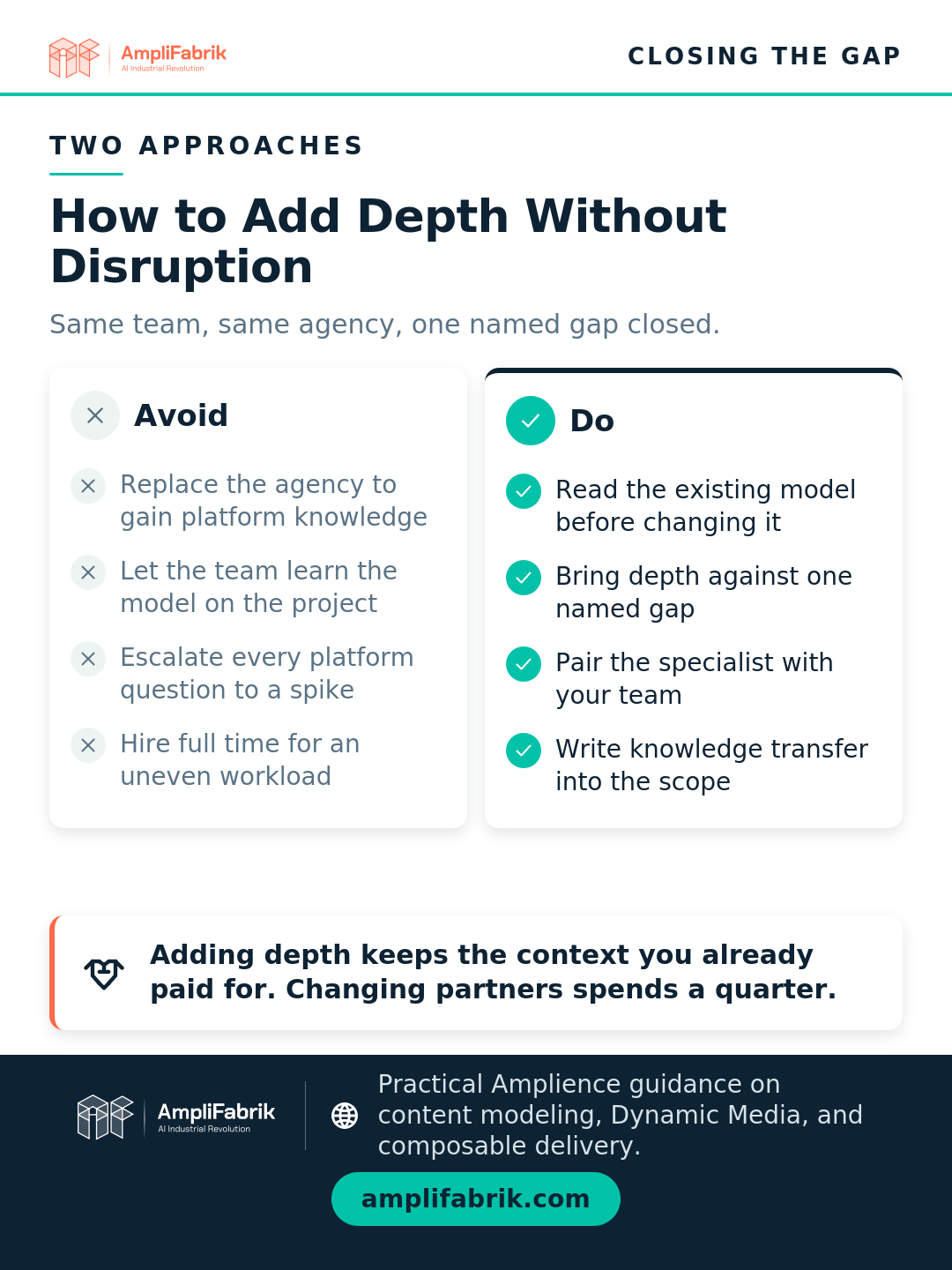
Key Takeaway: Add depth to the team you have. Changing partners to buy platform knowledge costs a quarter before it returns anything.
How do you tell whether the gap is real?
Five questions, and they are answerable in an afternoon without a consultant in the room.
Ask the team how many content types exist, and how many are instantiated more than twice. A long tail of single-use types is a modeling answer, not a content answer. Ask what happens to the storefront cache when an author publishes. Ask how a schema change reaches production, and listen for whether the answer involves a person clicking. Ask which content is scheduled rather than published manually. Then ask how long the last "add one field" request took end to end.
That question is the one AmpliFabrik asks first on a new engagement, before looking at the backlog, because the answer separates a team that is busy from a team that is blocked. A field addition that takes a day is a healthy model. Three weeks means the schema is load-bearing in ways nobody intended, and the backlog is a symptom rather than the problem.
Key Takeaway: Time one field addition from request to live. Under a day is healthy. Over a week, the model is the constraint.
How AmpliFabrik works alongside an existing team
We are brought in next to a team, not over one, and the engagement is scoped so that distinction survives contact with a deadline.
The first piece of work is a read rather than a build. We go through the existing content types, the delivery layer and the release path, and produce the symptom-to-cause list for that specific environment. That is usually enough on its own to settle whether the problem is architecture, capacity or priorities, and it is deliberately cheap, because a team does not need a project to find out which one they have.
From there it splits three ways depending on what the read found. A health check and remediation plan when the model is the constraint. An engineer or solutions architect inside the existing team when the gap is depth rather than direction. A delivery workstream when there is a defined build the team does not have room for.
What we will not do: take over the relationship with your current agency, rewrite working code because we would have written it differently, or leave without the reasoning documented. Knowledge transfer is written into the scope, because an engagement that ends with the same gap has not finished.
Conclusion: Time One Field Addition
Pick the last request that added a single field to a content type. Measure it from the moment someone asked to the moment it was live.
That number tells you more than a capability audit. It is quick to get, hard to argue with, and it points at the content model rather than at anyone's competence, which makes it a safer conversation to open with a team you want to keep.
If it comes back in weeks rather than hours, the next useful step is a read of the existing model by someone who has seen a few dozen of them. AmpliFabrik scopes that as a health check rather than a project, which means it ends in a prioritized list your current team can execute. Send the content model and the release path, and you get the list back. Nothing about who you already work with has to change.
Frequently Asked Questions
Can our existing developers learn Amplience on the job?
Yes, and many do. The question is what the learning costs and who absorbs it. Amplience documents nine core concept areas, and the ones that shape a build, content modeling, relationships and account structure, are decided early and are expensive to revisit. Learning on the project means those decisions get made at the point of least knowledge. Pairing a specialist with the team for the architectural phase is usually cheaper than the rework.
What does an Amplience specialist know that a senior developer does not?
Platform-specific behavior that is documented but not guessable: how editions and scheduling interact, when a content link should be a reference, what caching the Delivery API provides, how permissions map onto hubs and repositories, and how to promote schema changes between environments using the command line tooling rather than by hand. None of it is difficult. All of it takes a project to learn by trial.
Do we need a specialist permanently?
Rarely. The demand is uneven: heavy during modeling and integration, light during steady-state authoring, heavy again at a replatform or a major campaign structure change. That pattern suits an embedded engineer for a defined period or a support arrangement for platform questions, rather than a permanent hire that is underused for two quarters out of four.
Will bringing in a specialist undermine our current agency?
It depends entirely on how it is scoped. An engagement positioned as a review of the agency's work creates a defensive relationship and usually fails. One scoped against a named gap, with the specialist reporting into the same delivery process, tends not to. Say which it is in writing before anyone starts.
How quickly can a specialist be useful on an existing build?
Faster than on a new one, because the constraints are visible. Reading an existing content model, delivery layer and release path is a matter of days rather than weeks, and it produces a specific list rather than a general assessment. Building anything takes longer, since the onboarding surface on a composable stack covers the CMS, the commerce engine and the integration layer between them.
Sources
You may also be interested