Get in Touch
You Already Have Amplience. Now What? 10 Ways to Get More Value From Your Existing Implementation


Condividi la pagina:
Two years after go-live the platform is rarely the thing holding you back. The build is. Value leaks out of working Amplience implementations in ten fairly predictable places, and they fall into three groups: what is costing you money right now, what is slowing the team down, and what is blocking whatever you want to do next. Most of them are days of work rather than a reimplementation, and the ones worth doing first are usually not the ones on the roadmap. Here is the list and a way to triage it.
Introduction: The Platform Is Not the Bottleneck
There is a moment, somewhere between eighteen months and three years after go-live, when the conversation about a content platform changes. Nobody is asking whether it was the right choice any more. They are asking why it takes three weeks to do something that sounds like it should take three days.
The instinct at that point is to look at the platform. It is almost never the platform. Amplience has not changed much underneath you; the build on top of it has accumulated decisions, and some of those decisions are now load-bearing in ways nobody intended.
The good news is that the fixes are mostly small and independent. You do not have to reimplement anything to get a meaningful amount of value back.
What is costing you money right now?
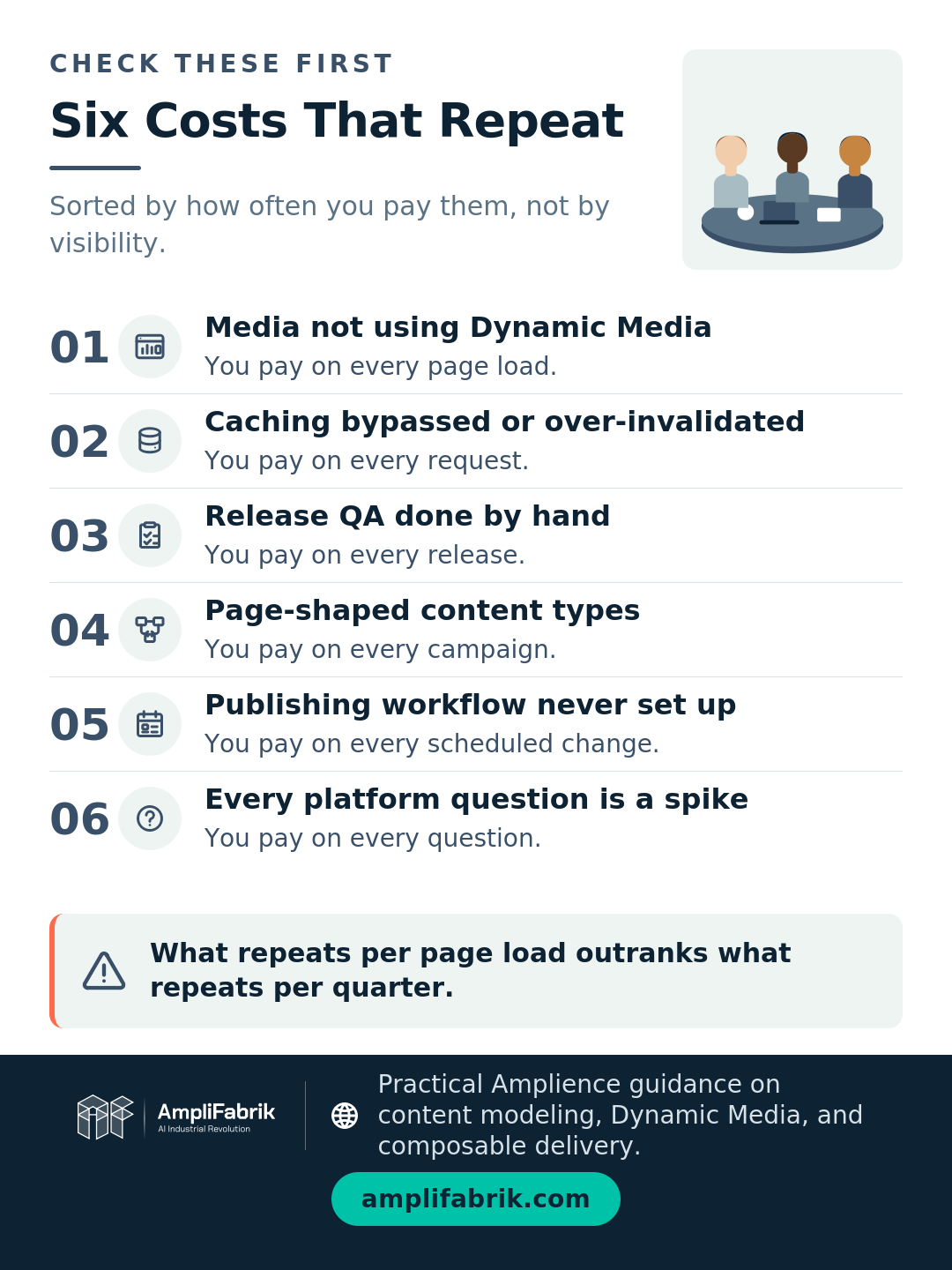
Three things, and they are the ones worth checking first because the cost is continuous.
1. Image and media delivery. Amplience Content Hub gives published assets "a dynamic URL, a static url, or both", and the dynamic ones can be manipulated through Dynamic Media. Builds that route around this, serving fixed exports rather than transformations, pay for it on every page load. It is a recurring find on AmpliFabrik health checks, still switched off two years after go-live, and it shows up directly in Core Web Vitals.
2. Caching and the delivery layer. Caching is one of the nine concept areas Amplience documents, described as how the Content Delivery APIs "deliver great performance". A front end that bypasses that, or invalidates too aggressively, turns a fast platform into a slow site and adds API volume nobody budgeted for.
3. Manual QA on every release. If a release needs a human to walk a checklist before it ships, that cost repeats forever. It is also the step that tends to get skipped under deadline pressure, which is exactly when it matters.
Key Takeaway: These three compound daily. Check them before anything on the roadmap.
What is slowing your team down?
Three more, and these are the ones people feel rather than measure.
4. The content model. Page-shaped content types, duplicated blocks, no hierarchy where the navigation needed one. The symptom is that every campaign needs a developer. The fix is content modeling work, and it is usually days rather than a project.
5. Publishing workflow. Amplience documents publishing and scheduling as a core concept, and plenty of builds never use it: authors publish items individually and hope the timing lines up. Scheduled editions exist precisely so a seasonal change goes live as one thing.
6. Developer support and platform depth. When every platform question becomes a spike, the team is paying a research tax on work that is documented. That is a knowledge gap rather than a capacity problem, and adding an engineer with platform depth to the existing team fixes it faster than hiring.
Key Takeaway: If a one-field change takes more than a day end to end, the constraint is in this group.
What is blocking what you want to do next?
Four items, and these are the ones that turn a roadmap conversation into a rebuild conversation if they are left alone.
7. API architecture. How the front end talks to Amplience decides how much of the roadmap is cheap. Builds that fetch whole hierarchies where a filtered query would do, or that have no separation between content retrieval and page assembly, find every new surface expensive.
8. Front-end integration. Rendering strategy, preview wiring, and whether publishing triggers a rebuild. Amplience's webhook integrations already carry this pattern for search indexes; the same hook can drive a static rebuild, and integration work to add it is small.
9. Personalization readiness. Personalization rarely fails on the personalization engine. It fails because the content model has no variant structure to target, so every rule needs a new content type. Readiness is a modeling question you can answer before buying anything.
10. Upgrades and environment promotion. Amplience ships a command line tool documented as a way to "automate and streamline your Amplience Dynamic Content workflows", covering how to "copy, import and export content types, schemas and settings" and how to "clean and clone hubs", from the command line or inside a CI/CD pipeline. Teams that do not know it exists promote changes by hand, which is why schema changes feel risky.
Key Takeaway: Items 7 to 10 are cheap now and expensive once the next initiative depends on them.
Which of the ten should you do first?
Not the ones on the roadmap, usually. Sort by whether the cost repeats.
Read the third column. Anything that repeats per page load or per release outranks anything that repeats per quarter, whatever the roadmap says. That ordering is boring and it is usually right.
Key Takeaway: Sort by how often the cost recurs, not by how visible the problem is.
How do you turn this into an audit rather than a wish list?
A list of ten improvements is a wish list until somebody puts numbers against it. Five steps, and it is a week of work rather than a phase.
Inventory what exists: content types and how many are actually instantiated, the delivery path, the release process. Measure the three continuous costs from the first group, because those are the ones with numbers attached. Time one representative change end to end, ideally a single field addition, since that number is the clearest proxy for model health. Then map each of the ten items to effort and recurrence, and stop. Producing a prioritized list and handing it to the existing team is a legitimate end point.
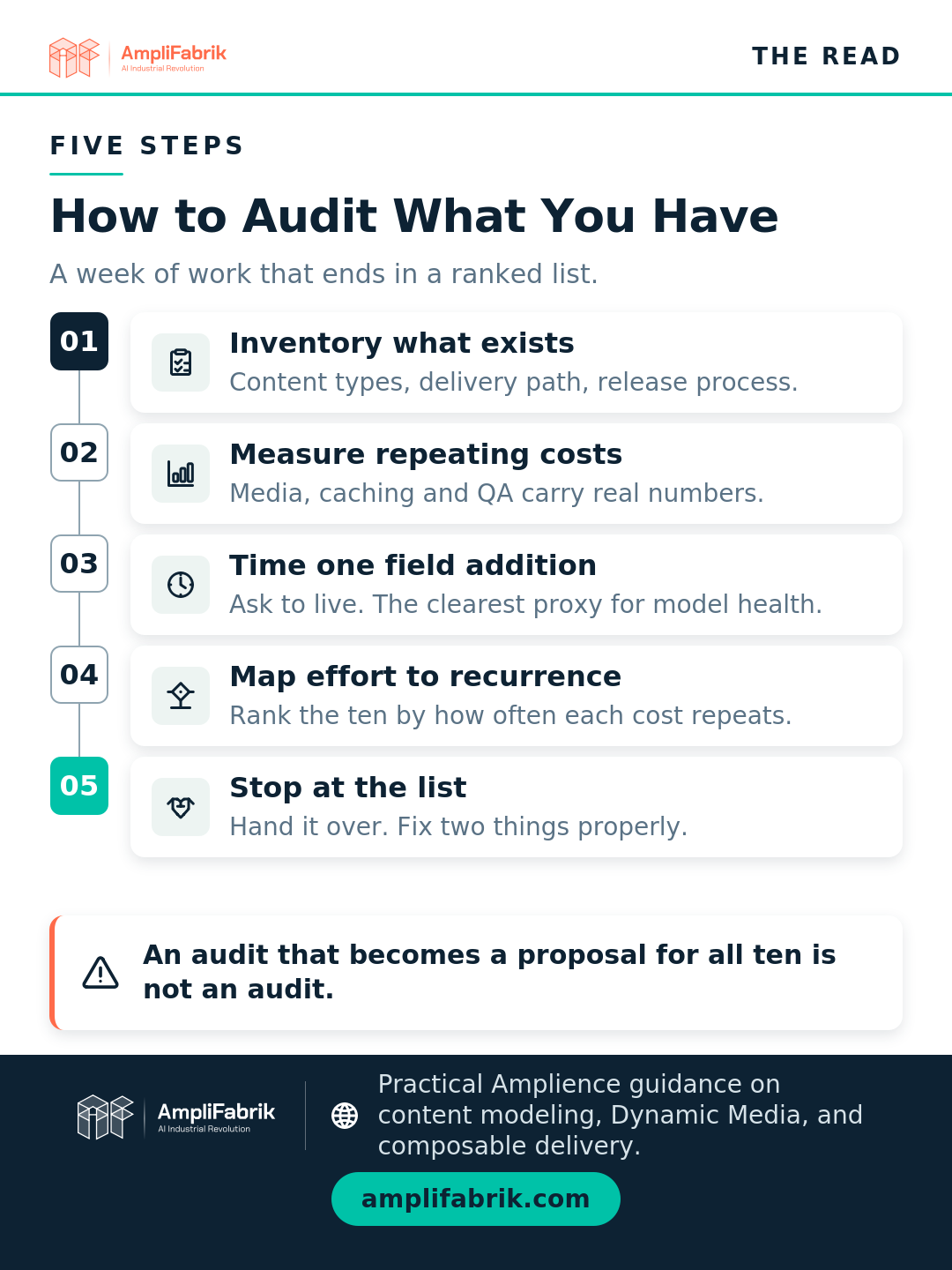
The discipline is stopping there. An audit that turns into a proposal for everything on the list is not an audit, and the teams that get value from this are the ones who fix two things properly rather than scoping ten. It is the reason AmpliFabrik caps the read at a fixed scope before any remediation is discussed: a findings document nobody is obliged to act on gets read more honestly than a proposal.
Key Takeaway: Finish with a ranked list, not a statement of work. Fix two things well.
How AmpliFabrik runs a lightweight Amplience audit
We scope this deliberately small, because the point is to find out what is true before anyone commits budget.
A health check runs the five steps above against your environment and ends in the ranked list. It covers the content model, the delivery and caching path, the release process and the media configuration, and it produces a document with each finding, its recurrence and a rough effort band. That is the deliverable. Your team can execute all of it without us, and some do.
Where it goes next depends on what the read found. Platform remediation when the model needs structural work. Delivery when there is a defined build. Staff when the gap is depth rather than direction and the work belongs inside your team.
What we will not do: turn a two-week read into a six-month program, or recommend a reimplementation when the list is made of days. If the honest answer is that four items are worth doing and the other six are not, that is the answer.
Conclusion: Time One Field Addition, Then Pick Two
Start with the measurement that costs nothing. Take the last request that added a single field to a content type and time it from ask to live. Under a day means the model is healthy and your constraints are elsewhere on the list. Weeks means item 4 outranks everything.
Then pick two from the ten and do them properly, rather than scoping all ten and starting none. The three in the first group are usually the right place to begin, because their cost repeats on every page load and every release rather than once a quarter.
If you want the ranked version for your own environment before committing anything, AmpliFabrik runs that as a fixed-scope health check that ends in a document you own and your existing team can execute. Send the content types and the release path, and the findings come back ranked.
Frequently Asked Questions
Do we need to reimplement Amplience to fix these?
Rarely, and it is worth resisting the suggestion. Eight of the ten items on this list are typically days to weeks of work against an existing build: media configuration, caching, publishing workflow, environment promotion and personalization readiness are configuration and modeling changes rather than rebuilds. Reimplementation becomes a real option when the content model is so page-shaped that reworking it touches every content type, which is a minority of cases.
How long does an Amplience technical audit take?
A focused read of an existing environment is normally a week or two, not a phase. It covers the content model, the delivery and caching path, the release process and media configuration, and ends in a ranked list with effort bands. If a proposed audit runs longer than a month before producing findings, ask what is being measured that takes that long.
Which of the ten gives the fastest return?
Usually media delivery and caching, because their cost repeats on every page load rather than per release or per campaign. Both are typically days of work. They are also the easiest to evidence afterwards, since the improvement shows up in Core Web Vitals rather than in how the team feels about the backlog.
We are already personalizing. Does readiness still apply?
Yes, and the symptom is specific: if each new personalization rule needs a new content type or a developer, the variant structure is missing from the model rather than the targeting being wrong. That is a modeling fix, and doing it before adding rules is much cheaper than after.
Can our current agency do this work?
Often, and it is the first thing to ask. The list in this article is deliberately written so an existing team can act on it without external help. Where outside depth helps is the reading rather than the fixing: someone who has seen a few dozen Amplience environments will produce the ranked list faster than a team seeing its own build for the first time.
Sources
You may also be interested